Spoken Word

Beauty From Ashes // Spoken Word Ed.

One of my dearest friends, Bobbi Jo Brooks made a painting for me last year entitled Beauty From Ashes. We spoke a lot about the themes of the painting and I fell in love with the painting and everything it represents. When she presented it to me, we talked about me one day writing a poem to accompany it. A year later, I finally managed to capture some of Bobbi Jo’s ideas in words. The fruit of that is displayed below.

For more of Bobbi Jo’s work, go to her website bobbijobrooks.com

https://youtu.be/idkQ8ANf7i4

Beauty from Ashesby Rebekah Eckard

If you stand far enough away,

you’ll only notice the gold and white running down my body.

I shimmer in the sunlight and dance in the shadows.

You call me beautiful. Lovely.

As Pretty as a Painting.
I am a work of art,

not meant to be admired but experienced.

Come closer and touch me.

See for yourself what I truly am.

Run your fingers along my skin,

and find that I am not just a shell.

There is more to my story than what your eyes can see.


I am not a blank canvas.

Underneath my beauty there is a past.

There is always a past.

It’s only when you get close enough

that you begin to see the bumps and bruises-

the accumulation of ash that lies beneath

Years and years of failed perfection

Heaped upon the burning fragments

Of unmet expectations, hopes dashed from the rooftops,

falling short in all the ways I wanted to succeed.

Yet the artist took me as I was.

My bumps and bruises not a hindrance

But a foundation to be built upon.

Color and paint poured over and over

Soothing my enflamed wounds.

Making wonder from the darkest parts of me.

I can feel these new elements forever changing who I am.

Not hiding, but transforming.

Ash glittering into gold.

Ridged landscapes smoothing into porcelain.

So you see beauty where once was brokenness.
Yes, I am more than a pretty picture.

I am a living, breathing story

Echoing throughout time.

Ashes to Beauty.

Death to Life.

Come closer and see for yourself.

Come closer, and see yourself.

Ramblings

The Secret to Creativity

IMG_8248(1)
Photo by my dear and talented friend, Bobbi Jo Brooks

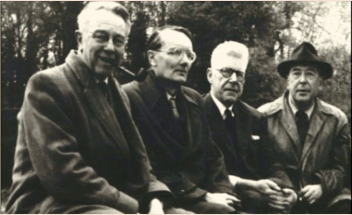
Over the years, I’ve made a habit out of celebrating the Friendiversary of C.S. Lewis and J.R.R. Tolkien on May 11th every year. Wether this is truly  the day they met matters little to me. Instead, I let this made up holiday serve as a reminder of why I make time for creative community in my life.

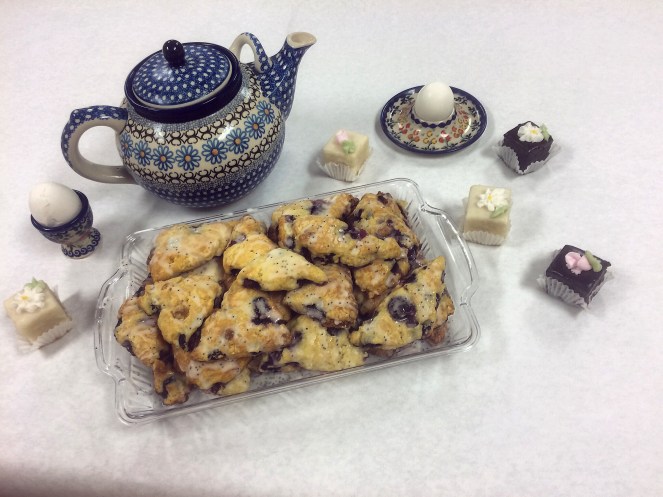
I usually celebrate by making scones, drinking tea, and reading some old favorites. This year was a little different. I spent the day camping with dear friends, miles from the nearest cell phone signal. As the sun set behind an old country lake, we ate barbeque and sat until midnight talking by campfire. My post this year is a little late, but I like to think that Lewis and Tolkien would have approved of my choices. You see, while I like to celebrate their friendiversary on May 11th, their habit of being active in creative community is something we can practice year round.

I remember when I first started writing. Alone with my lukewarm coffee, I would sit on my porch morning after morning trying to create magic out of nothing. Truth be told, my hands spent more time on my head than on my keyboard. But that was the life I had chosen as a writer, or so I thought. I pictured Lewis, walking down an old country road, brilliantly forming complex characters in his mind which he would put to pen as soon as he got home. Tolkien, I saw, sitting in his study with the fire slowly burning down into ash, laboring over his languages while everyone else was snuggled in their beds.

Both of these men did indeed have their moments of solitude, but what is truly fascinating is not how they worked as individuals, but how they cultivated a friendship that spurred each other on to be who they were created to be.

Hear this. These men met together regularly and learned from each other for many years. They did work in solitude, but they also spent a significant portion of time sharing their work with one another and asking for feedback and critique. I think so often we only see Lewis and Tolkien as they were at the end of their lives, and we fail to remember that they were ordinary people who needed help, encouragement, and sometimes even strong critique. I would like to submit to you all that it was their friendship with one another, and the company they kept, that spurred their genius. I believe that their literary masterpieces are a direct result of their friendship.

Before the Inklings, Lewis was a mostly unknown poet who had never tried his hand at fiction. Tolkien was a philologist who was more interested in creating languages than chiseling away at a plot.

How many of us have held our breath alongside Ransome as we watched the battle of the Garden take place once more on Perelandra, hoping that this time mankind would make the right decision? And yet, it was Tolkien who dared Lewis to write a story about space travel in the first place.

How many of us have mourned the loss of beauty in a once-untouched middle earth and smiled ear to ear at every mention of a second breakfast? And yet, it was Lewis who encouraged Tolkien to spend less time creating languages and elvish anthologies and more time writing plots.

In order for these two men to become who they were created to be, they needed each other.

These men discovered – or rather, rediscovered – the secret to creativity: community. We were not made to work in solitude, but to share, to borrow, and to build upon each other.

I passionately believe that every artist needs their Inklings. You might be thinking, “Yes, well, I’d love it if there was a group like that around me, but there isn’t.” Well then, I’m challenging you to create one. All you need is one person in your field, a place to meet, and a desire to see each other succeed. I think so often we keep waiting for our own personal Lewis and Tolkien to show up at our door and meanwhile we miss the life-filled, flesh-and-bone artists around us.

In the fall of 2016, I was just beginning to try my hand at fiction. I attended a novel-writing course that met once a week for eight weeks. Two of the women from my course and I began meeting at coffee shops throughout the city to sit quietly at a table and write together. It was painstakingly wonderful. I’d go even when I didn’t feel like writing and I’d write. When one of us had writer’s block, we talked it out. Slowly, we found we didn’t just need each others’ presence and encouragement; we also craved each other’s feedback.

Nearly a year after that first writing class, four of us gathered in a living room with chapters of our novels in hand. We met again two weeks later, each bringing new chapters. A few months later, we invited another person to join us. Within the next year, we gained another new face. Finally, our numbers were at six. Six people from five different countries speaking four different mother tongues. We had very little in common, but we showed up at each other’s houses twice a month and we did the most gracious, loving thing we could do for one another: We tore each other’s novels apart.

We pointed out plot holes, spelling errors, flimsy characters, repeated lines, everything. It hurt. It was embarrassing. But each time I left that group thinking, “of course! Why didn’t I see that before?” Three years later, these people know my novel just about as well as I do. This group has been my eyes when I was too blind to see past the next chapter. They have picked up my pen and dipped it in ink when I wanted to call it quits. They have coupled encouragement with critique, and they have turned this lonely task of writing into a story of how I found my people and found my voice.

There was no Lewis, no Tolkien, no Barfield, but we kept meeting and we kept growing. We never intended to start a long-term writing group, we just kept showing up. If you know one other artist, you can start a creative community. That’s all it takes. Two people with a commitment to show up in a common, physical space every week and lovingly make each other better. Anyone could do this. You could do this.

I believe that our success as artists directly correlates to the community around us. Today, I’m not just celebrating Tolkien and Lewis, I am celebrating the six people who sit in a living room with me twice a month and make my creation more lovely, more true, and more captivating than it could ever be with just me.

If you don’t have your Inklings, I challenge you to find them. It will take time, but find them and let them revolutionize your work. They will, I promise.

 

Ramblings

Inklings of my own


Inklings 2018 pic     It’s that day again… the day I bake scones, drink coffee with friends and celebrate two wonderful writers whose works cultivated a love for myths in me at an early age. C.S. Lewis, author of The Chronicles of Narnia, and J.R.R. Tolkien, author of The Lord of the Rings, met on this day over ninety years ago. Shortly thereafter, Tolkien sent Lewis an epic poem he had written. It was filled with lore and myth and the fantastical realm, passions they both shared. Lewis returned the poem several days later with notes, critiques and even suggestions for how Tolkien could make his lines flow better. Can you imagine actually critiquing Tolkien? It sounds almost absurd. But Lewis did, as well as passing along one of his own poems. And so began a small community revolving around this idea of sharing and critiquing one another’s works. You might know them as the Inklings.

But today, instead of talking about the original Inklings, and their vast influence on each other and the countless books birthed through their gatherings, I want to tell you about my own set of Inklings.

In 2016, I moved to Berlin for a 9-month internship. (Yes. Yes. Two years later I’m still here, but that’s another story.) About three months in, I realized the short story that I had been playing around with wasn’t a short story. Much to my great displeasure, it was a novel. I was a little baby writer who had written a mere handful of things. This craft was new to me, and I had no idea what I was doing. To be cliché, I found myself in front of a mountain with no map, no supplies, and no training whatsoever.

By grace, I had moved to a city that embraces artists and I found a writing class targeted toward people who were just starting to write their novels and needed guidance. Oddly specific right? Kate, my teacher was brilliant, wise, experienced and kind. (*Insert shameless plug for the Reader Berlin and Kate who is AMAZING).

We spent the first four weeks learning the basics of novel writing, and the last four weeks reading a chapter of each other’s work and critiquing the pieces in class. Once again, I had no idea what I was doing. My typical response to art had always been “I really liked it” or “this is so beautiful.” And that wasn’t good enough here. It was fine to say those two phrases, but it needed to be followed by a “because…” or a “but…”

I also learned it was okay not to say those two phrases. That is was perfectly fine to look at a writer and politely say, “you know, this wasn’t really my thing. However, I did appreciate when you…” For a half-southern girl raised in the land of buttered words and sugared expressions, being open and honest when I didn’t like something felt like I was slapping someone in the face and kicking them in the stomach once they fell in the dirt.    But then it was my turn to have my piece critiqued, and I realized that critique isn’t a slap in the face at all, but a friend telling me to pick up the pen and try again. Critique can be a loving teacher pointing out what I need to work on and how I could improve. Every single person at that table took time to read my work, think about how it could improve, and share their thoughts with me. They didn’t do this to be cruel, they did this so that one day my dream of seeing Aedaliegh of Arceldör in a bookstore might become reality.

When the course ended, a few of us would meet at coffee shops throughout the city to sit quietly at a table and write together. The next course came and we signed up again, seeking more feedback and more knowledge of writing as a craft. When Kate offered her next course, an entire 10 weeks solely spent reading and critiquing each other’s work, I immediately signed up. This, I was learning, was how I really get my novel to go somewhere. Yes, it was helpful to learn about different styles of narration, using third person verse first person, and so much more. But I found that the critique is what spurred my book to be better. Not just when my own piece was critiqued, but also in the critiquing of others I learned what worked and what didn’t,  to spot a mistake, and even to anticipate what some of the feedback might be and make it better as I was writing the first draft.

Somewhere at the end of the third course, Kate hinted that some of us might be able to do this critique thing on our own. As we walked back to the subway that night, a few of us asked, “Could we really do this? Start our own group? Do we even want to?”

That August, five of us met in a living room and began this process on our own. We didn’t know how long it would last, but we wanted to see where it would go. It’s been hard. We’re all incredibly busy. Some of us have families. Some of us have had to leave the country for three months. I started a new job that makes me get up at 4:30 am on Tuesdays even though writing group last until 10 or 11 pm on Monday nights. We have had to make sacrificed to be in this group. We’re tired. We have little time. But all of us have made our books and this group a priority because we know it is one of the keys to our success.

A few weeks ago, I shared a scene I’d been hiding from this group for nearly two years. I was so nervous they would read this scene, throw the paper across the room and say something like, “What in the world, Bekah! You must be absolutely insane to write something like this.” But after two years with the group, I finally decided I trust them enough to share it. They loved it, which is still the most shocking thing that’s happened. They absolutely loved it and made me promise not to take it out. Then came the “but..” at the end of the chapter with a really sweet and lovely little moment I had written between Aeda and Fryderik. And my girl, Laura, looked at me, and said, “I was shocked because Aeda would never do this. It’s not her at all.”

She was right. It took me a minute to see what she was saying, but it hit me. Aeda would never do what I had her doing at the end of this scene. It went against everything she was. That night, Aeda got a wardrobe change, and all because Laura, over the past two years, has gotten to know my character almost as good as I have. I’ve said it for the last two years and I’ll say it again now…

The secret to creativity is to surround ourselves with a community. We were not made to work in solitude, but to share, to borrow, and to build upon each other.

When I tell people about this group, and what we do, they always say, “Oh, I must be hard to critique someone’s work. I could never do that.” And while that used to be my same opinion, I reply, “It’s not so hard after a while. I love their work, and I want to see them succeed.” And it’s true. I want to buy their books one day. I want them to buy mine. And in order for that to happen, you need more than one set of eyes.

The secret to the Inklings success was each other. C.S. Lewis may have never gotten some of his works published had it not been for Tolkien’s connections and recommendations (not to mention that his Space Trilogy actually started out as a dare from Tolkien.) Tolkien may have never gotten his head out of languages and anthologies long enough to write a plot had it not been for Lewis urging him to write the next chapter so that he could see what happens in the story.

If I ever get Aeda published, it will be because of these women. They have kept me writing when I was tired and wanted to forget Aeda altogether. They have given me ideas when I had no idea where to go. They have given me encouragement and critique. They have helped me see things I never did, and have made turned this lonely task of writing into a story of how I found my people.

I passionately believe that every Artist needs their Inklings. I will never stop proclaiming this. If you’re a lonely artist, you don’t have to be. Join a group. Create a group. Less than two years ago, these five women were strangers from five different parts of the world with three different mother tongues. And yet, two years later, here we are because we showed up, we spent time thinking through each other’s work, and we were honest with one another.

I believe that our success as artists directly correlates to the community around us. Today, I celebrate the five women who sit in a living room with me once a month and make Aeda more lovely, more true, and more captivating than she could ever be with just me.

If you don’t have your Inklings, find them. It will take time, but find them and let them revolutionize your work. They will, I promise.


Spoken Word

Jupiter

As mentioned in the video, one of my goals for this year (as well as continuing to work on my children’s novel, “Aedaliegh of Arceldör“) is to write seven poems based off of the book by Michael Ward, Planet Narnia,as well as the Chronicles themselves.

The first piece, entitled “Jupiter” ,  is based off the first book Lewis wrote “The Lion, the Witch, and the Wardrobe.”

Enjoy! And hopefully, there will be more to come soon.

https://youtu.be/x3NBMy6P608

Jupiter

The world has been drained of it’s color like hope from our souls.

We stay huddled in our houses, scared of what the woods might hold.

We’re are covered in white and frozen in fear,

too scared to raise our voices- too scared the trees might hear.

Still, we grasp at ancient words and hold fast to the hope

of a king that is coming, breaking through the snow

They say when he comes, all will be made right.

They say when he comes, we’ll dance unhindered in the light.

And at the sound of his name, our hearts begin to beat

like an army of warriors being woken from winter’s sleep.

Do you hear the red robin’s song echoes loudly through the trees?

Behold the brook begin to bubble like joy overflowing from the deep.

Shoots are springing from the ground as snow fades away.

Look there, the sun rising red as day begins to break.

Frozen rivers part and blossoms release their blooms

as if all of creation felt our longing to be renewed.

So we shed our winter coats like a profession of faith,

trading our fears for swords there along the bank.

Our faces glow red with the warmth of the sun

as we bow before the king- the one who’s finally come.

King Jupiter you are- The king above all kings.

You roar with laughter and reign in magnanimity.

You are lion-hearted, and yet saturated in peace.

You are joviality and song-  the very picture of Spring.

But winter has followed us and she is staking her claim.

She points out all our failures, our follies, our mistakes.

She tells us we’re not worthy to dance in summer’s sun,

but her voice is overshadowed by the king declaring “come!”

Thunder claps over us as cold collides with warmth.

We shiver at the shadows, yet still we raise our swords.

And just when darkness seems to swallow us whole,

we look up to find the dawn rolling in, igniting hope.

Like the morning sun spreading slowly across a field,

our king descends, proving he both conqueror and shield.

And we can but simply watch as his beauty mingles with his wrath.

Conquering what we could not, he is the king we always lacked.

He calls us before him and crowns us with new names.

We are Gentle. We are Just. Magnificent and Brave.

We take our place beside him and to this great joy we cling:

We are no more than servants; we are no less than kings.

Spoken Word

Ink

Surprise, Surpise. I wrote another poem* about my tattoos. I read it at a friend of mines party this week and thought I’d share it here. One day, I’d like to be one of those spoken word artists whose words pour out from their mouths slowly like molasses, full of body and rich flavor. Until then, I’ll hold tightly to my phone and say one too many “um”s before I start. We’re all learning how to be creatives. We all learning to speak boldly and look people in the eyes as we say “yes, I’m an artist.” 

*I wouldn’t really call it a poem, more of a “rhythmic rant.”

If you’re in Berlin, stop by “Art on the Terrace” and join our little creative community. 

Aedaliegh of Arceldör · Short Stories · Songs · Spoken Word

Stomp ( A Folk Song)

Okay,y’all. I need your help. Below you will find an excerpt from the (children’s) novel I’m working on. It’s a scene I’ve been playing with for a while, and simply can’t figure out how to make the *stomp* part work in print. So, I would love and appreciate your input and ideas on how to best convey what I see and hear in my head. This is group effort, so y’all chime in.

bonfire-painting
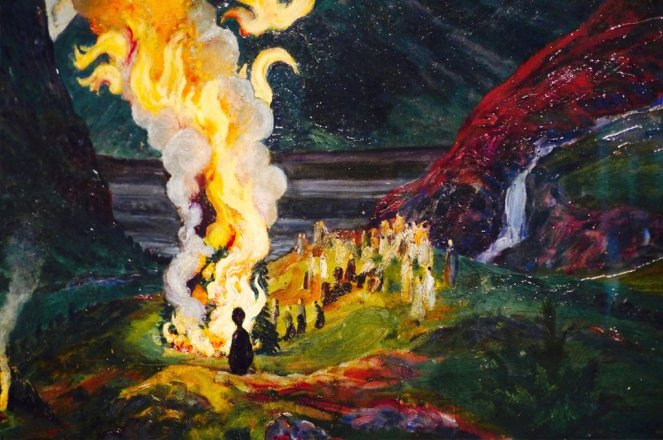
Nikolai Astrup’s Midsummer Eve Bonfire, 1912.


Tonight, it was the Gehimni people who were given the honor of entertaining. More than twenty Gehimni men and women ran around the fire, hollering and making noise. It snowed in the Gehimnis for nine months out of the year, and so most of the bed had long beards that covered the majority of their face, and the women wore long skirts made of animal skin with all kinds of braids strung about in their hair. Suddenly, the Gehimini performers stopped running around the fire, and the women took their spots in a circle on the ground. A man began to strum a mandolin, as the others began to stomp their feet to his rhythm. The men threw their knees high up in the air only to bring their smashing back down with the force of a ten horses. Each of the Gehmini men fell in sync with one another until one man threw his head back and howled at the top of his lungs, Ooooooooooooohhhh, and the other men followed his lead.

I’ve seen the mountain tops and I’ve gaped at the sea,

but never has this wanderer beheld a beauty such as thee.

I’d scale the mountains tops and sail across the sea,

if you’d be waiting for me with a white dress and a ring.


Yer nose is as pointy as the snowy peaks,

and yer eyes are more emerald than the evergreen.

I know I ain’t much to look at, my darling sweet,

but I got heart a gold somewhere underneath.


My heart when it saw you went *stomp stomp stomp*

And my lips started singing this horrid song.

But my dear please know that if you love me so,

I’ll sing this song to you until we’re grey and old.


I’ve got a house here in these woods, I bet yer Papa would be proud.

‘Gotta fireplace and a porch that goes all around,

but I’m stilling miss something, perhaps a spritely frau.

So what do ye say, will ye marry me now?


The women sitting on the edge of the crowd jumped up and joined arms with the men, and together they danced a polka around the fire. They weren’t the best of singers, but that didn’t stop every single man and woman from singing, or rather yelling, at the top of his or her lungs. If only they would sing on key, they’d be quite good. The entire camp was mesmerized by them, and they joined in with the stomping and clapping with just as much vigor as if they had known the songs their entire lives.


Darlin’ let me dance with you until this night ends.

Yes, come a little closer. I don’t mind those hairs on yer chin.

Yer back is strong from plowing and I sure do love yer apple pie.

Oh, you’re the only woman who could ever catch my eye.


My heart when it saw you went  *stomp stomp stomp*

And my lips started singing this horrid song

But my dear please know that if you love me so

I’ll sing this song to you until we’re grey and old.

Yes, I’ll sing this song to you until we’re grey and old.


Also, would English speaking children know what a “frau” is? Can I use that word in a “fantasy” novel?  Thoughts? Comments? Suggestions?

Ramblings · Uncategorized

Happy Birthday Little Blog

One year ago today, I started a challenge to cut back on my consumption, and spend at least fifteen minutes every day creating. There were no other parameters. I could knit. I could draw. I could write. Yes, I would write.  I didn’t know if I would  make it through a whole year, but I thought I could try. So I spent the last year establishing a habit of creativity.

And let me tell you friend, this is a habit I will cultivate the rest of my life.


In the beginning, there were days where sitting down to write seemed like the hardest thing I could ever to do. There were nights where I would come home, and I just wanted to fall asleep. But I didn’t do that. I pulled out my computer, and I forced my keyboard  to form pictures  out of words.

And it has changed the way I live each day.

Now, I know I’m prone to hyperboles, so some of you may not be believe me when I say this. However, my hope is that by the end of this blog/rant you may grasp the tremendous effect of a small habit. My hope is that you may be encouraged to do the same as I did. To pick up a paintbrush. To put your words down on a page. To do whatever it is your hands have been tingling to create.

So, you want proof, right? How did this silly little habit change my life? I took a long list of twelve, and narrowed it down to two things that this habit of creativity is teaching me. Neither one has anything to do with skill or craft mastery, because that is not what’s important. I’m not asking you to spend time creating so that you can be a better artist (although that will indeed happen), but because I know that along the way you will grow more in love with your Maker, his creation, and -dare I say it- yourself. So, without further ado…

2 things Creativity is teaching me.

1. There is still magic to be found in this broken world. 

I mentioned a few moments ago that when I first began this endeavor, I struggled with what to write about. It would take me an entire month to write a poem. I didn’t know how to generate ideas. My friends will tell you I’m a do-er.  Give me a task and I become a horse with blinders. The end is all I can see, and I’m going to run as fast as I can to get there. But that’s now how Creativity works. You can’t force it. It’s not something you can mark off your to do lists.

Creativity for me is a lot like Pokemon Go. (I bet you never saw that sentence coming.)  You can’t sit in your house on your computer and wait for cute little monsters to show up at your doorstep. You have to go out into the world and walk around a bit. Only instead of searching for Pokemon, you’re searching for beauty – for magic.  You’re searching for something that makes your heart sing. And when you find it, pull out that Poke Ball and capture it (which is easier said than done, I know). Stick  it in iPhone Notes App and let it grow. Collect more, and let them grow. They will evolve and become stronger and more beautiful. And then, that’s when you share them.  Because beauty is a lot like the little boy with two fish and five loaves. When you have something to offer, you may not think it’s enough, but offer it up anyways. And the next thing you know, it’s the hands of One who can take your small offering and feed a crowd of thousands. The more beauty is shared, the more it multiplies.

So when the shopkeeper down the street is laughing loudly with his brother like an unhindered child, catch it. When the sun makes the cobblestone streets glow a dull pink color just before sunset, catch it.

Because YES, in the midst of all the bombings and strife and wars and hate-filled speeches, there is still beauty to be found. I’ve seen it. I’ve experienced it. And I want to share it. I want to bring it out of the background of our photographs and into the forefront of ours minds. When we have long forgotten about our Maker and Savior, it is beauty that can bring us back. It is beauty that can give us hope, that just maybe, things won’t always be this way. Could it be that there’s more to this life than toil and pain?

Yes. And I’ve got Poke balls full of moments to prove it.

My iPhone Notes App is filled with lines of poems I have yet to finish. (It’s kind of a mess, really.) In between grocery lists and to do lists and all sorts of lists, I’ll find these little gems: two or three lines of a poem or a song, or an idea for a short story that I typed out while waiting in line or  walking home from work. I’m learning to channel a simple moment into verse. You don’t have to “catch em all”, but what if you just started just searching for one?

2. There is no such thing as failure. 

Before this year, I had never tried watercolor. I had always loved the feeling of brush stroke swishing across a page, but I was afraid I wouldn’t be good at it. Now is the time when I would very much like want to go off on a philosophical tangent about what “being good at” something even means, but I won’t do that. Because frankly, it doesn’t matter. You see, it doesn’t matter if your flowers look like mud puddles when you draw. Do you enjoy it? Wonderful, then draw. If it is moral and physically/financially possible for you, and you enjoy it -whatever “it” is- then do it. It doesn’t matter if you’re good at it. What matters is that it’s good for you.

That’s what I love about art really. It’s so gracious. Art by very definition is experimental. It molds over time and with each person who handles it. It doesn’t judge but simply submits itself to whatever the artist needs from it. Art doesn’t seek results, it seeks transformation. It seeks communication. Any criticism that we receive comes not from the our creation, but from ourselves. This year, I have learned to accept that I am human. In fact, I’ve learned to enjoy it. This life-long learning curve can be fun if you free yourself from this silly idea of perfection.

I’ve been wanting to write “A Fortress for Aeda” for years. I kept myself from it, because I knew I would never be as good as C.S. Lewis. I’m not kidding; that’s why I didn’t write. I was embarrassed that I would never be the writer that he is. And while I still treasure him as a writer, I’m learning to love myself as a writer as well. I like the way I see things. I like that I’m a cynic who writes fairy tales. And I believe that the stories I’m writing needs to be heard, just as I believe every child everyone should read the Chronicles of Narnia.

I’m going to tell my stories with all the beauty and charm and goodness that I can muster. And that is enough.


In short, this year I realized that being a dreamer was a good thing, because dreamers see the world as it will be. And I am learning how to take those dreams and slowly bring them into being. And yes, I’m probably not going to be the next Lewis. But when we stop defining success as a destination and more of journey, then we don’t have to be afraid of failure because it won’t exist. But if we simply strive to call beauty out from it’s hiding place, then every day we can work with joy knowing that what we have to offer matters.

Oh, and my big announcement?

A Fortress for Aeda is currently going through (and has been for several months) some very intensive rewriting and editing sessions. She’s getting new chapters and her old ones are getting reworked because, well, I’m going to publish her.

The goal is to have “A Fortress for Aeda” out by Thanksgiving. (Okay, Christmas at the very latest).

A year ago, I’d barely written anything. I just had this dream of one day writing a novel. Maybe. And I’ve still got so far to go. But I’m taking hold of my dream. I’m working towards it. And it started with 15 minutes.

So, please friend. Start today. Right now. Pull out those pencils, go buy that new watercolor pallet, start that story you’ve been writing in your head. Get your hands dirty with beauty.

You have the time. You have the creativity (I promise you). And you can not fail.


Ramblings · Uncategorized

Find Your Inklings [Creating in Community]

Today’s blog is in honor of Lewis & Tolkien’s Friendiversary. So go grab yourself a scone and a cup of tea, and your favorite book. And remind yourself of the beautiful things that can be created when we surround ourselves with people who help us dream.

Image

A few weeks ago, I found an amazon gift card I received -and promptly lost- as a Christmas present. This led to an impulsive splurge on Amazon with the first book I could find. Two days later (shout out to amazon prime), I found “a Hobbit, a Wardrobe, and a Great War” sitting on my doorstep. True to it’s title, the book considers how the first World War influenced the writings of Tolkien and Lewis, who spent time in the trenches as foot soldiers. I’ve never been detail oriented enough to sit through a history lesson well, but throw in a story and you’ll have me hanging off the edge of my seat. And that’s exactly what Loconte does, weaving in both Tolkien’s and Lewis’s personal experiences while also casting a broad scope of the War and it’s effects on England.

Almost inevitably I came across a section on the friendship between Lewis, Tolkien and the rest of the Inklings and I found myself gripping the page tightly and smiling like a fool. Most of us have probably heard of the famous group that met together at Oxford. However, it was upon reading this portion of the book that I began to understand the magnitude of their devotion to one another. For sixteen years, the group met every Tuesday morning and Thursday night to share their stories with one another. Even -perhaps especially- in the midst of the Second World War, they continued to meet. Even once their time together had ended, Lewis and Tolkien continued meeting and reading each other’s writings aloud to the other. Tolkien, said of Lewis in a letter,

“C.S. Lewis is a very old friend and colleague of mine, and indeed I owe to his encouragement the fact that in spite of every obstacle [including the 1939 war] I persevered and eventually finished The Lord of the Rings. He heard all of it, bit by bit, read aloud.”

Think about the countless hours Lewis and Tolkien must have spent reading through Lord of the Rings together.  Lewis, probably being the first to ever hear parts of the story, had a critical role in it’s completion. In a time when fantasy and heroes had been exchanged for skepticism and machinery, Lewis saw the NEED for Tolkien’s story to be told. He saw a need for the public of England, blinded with the Enlightenment, to experience and believe in myth, in hero, and in adventure once again. He saw the need for the simple country folk to understand what could become of a world that tears down the Shire to build factories upon it. And He saw the need for a generation of men to mourn those lost in the war.

“So much of your whole life,” said Lewis in a letter to Tolkien,” so much of our joint life, so much of the war, so much that seemed to be slipping away quite spurlos [without a trace] into the past, is now, in a sort made permanent.” While Tolkien had his head stuck in piles of paper and ink, Lewis was able to look upwards- toward the future- and see what would become of all of it. And when it came time for Lewis to publish his own tales, The Chronicles of Narnia, it was Tolkien who wrote to his publisher, imploring him to consider the books.

As I sit here, in a coffee shop some eighty years later, I can’t help but draw parallels to my own hardships as a writer. I’ve had a story of my own stuck in my head for four years now, though I haven’t had the courage to start writing it until recently. As I set about putting it in print, I realized I had some major plot holes in the story. I tried to come up with a creative solution, but I just could not get past them. I kept telling myself, “No, that’s stupid, that won’t work” over and over again. (Let me tell you right now that there’s nothing that kills creativity more than a good dose of self doubt.) But one day, as I found myself without internet access and sitting on my best friend’s couch, I began talking through my story with her. For the better part of an hour, she sat there and just listened. And then, something miraculous happened: she told me I wasn’t stupid and told me to keep talking. She told me my idea wasn’t as horrible as I thought, that it might actually be beautiful. I felt like a paralytic who had just been healed- ever stagnant but now could get up and walk -maybe even run- wherever I chose. One week later, I had written through one plot hole, finding hope and confidence that I could overcome the others that I would face. So, when reading of the consistent support that Lewis and Tolkien had for one another, I wondered if maybe this is the secret to creativity. And I’d like to submit to you that it just might be. That in order for us to thrive as artists, we need a friend to come along side us and say “Your idea isn’t ridiculous, it’s beautiful. You have to do this.” When we are stuck in the moment and all we can see is that obstacle we don’t think we can get past- when all we can hear are the no’s and cannot’s, we need someone to walk up and speak loudly, “Yes, you can. And if you can’t, then we’ll do it together. Because what you have to say is beautiful and what you have to say is needed. This broken world needs the light that you’re bringing into being.” There’s a reason almost every book or CD on the shelf has an acknowledgements section. It doesn’t matter whose name is on the cover, we all know it wasn’t a singular endeavor. We all have someone to thank for helping us finish the work that was started.

Even our Maker did not do His work alone. In the beginning, when God created the heavens, He chose to do it in community with himself. Our trinitarian Lord- the Father, the Son, and the Holy Spirit- collaborated for the making of his masterpiece. “Come, let us make man in our image.” Minds in one accord with one another planned and plotted together, speaking affirmation after each creation, “Yes, indeed, it is good.” The Almighty created in community, and that should serve a strong lesson for those of us, who are only makers mirroring Him in whose image we were formed. We can never be too good at our craft to walk this journey alone. Community is an essential part of our Creator, and it’s an essential part of us who are made in His image.

So, friend, whatever your obstacle or “plot hole” is at the moment, find someone who’s willing to spend an hour just listening to you. Find someone who sees the beauty is what you’re doing, and who can speak that over you when you’ve lost your sight. Find someone who will let you return the favor. Creativity isn’t meant to be done in solitude; it’s meant to be borrowed and shared and built upon.

So go out and find your Inklings, for we were never meant to create alone. 


Screen Shot 2016-05-10 at 4.53.26 PM
The Inklings

Screen Shot 2016-05-10 at 4.52.45 PM

Aedaliegh of Arceldör · Short Stories

A Fortress for Aeda, Part 4

wolf geo
Hi Friends! Welcome to Part 4 of my short(ish) story  A Fortress for Aeda. This story has become so much more than I originally intended it to be, and I couldn’t be more thrilled. To start at the beginning, go here to find Part 1.

And thanks for stopping by.

You’re the G.O.A.T.

Or the wolf, whichever you prefer.


A Fortress for Aeda is currently under construction. Come back later for some exciting news.